
Redundant Deployment to Prevent Unexpected Downtime
When a network device is used with a dual-feed PDU, if the primary power feed fails, the device will automatically switch power to the other source.
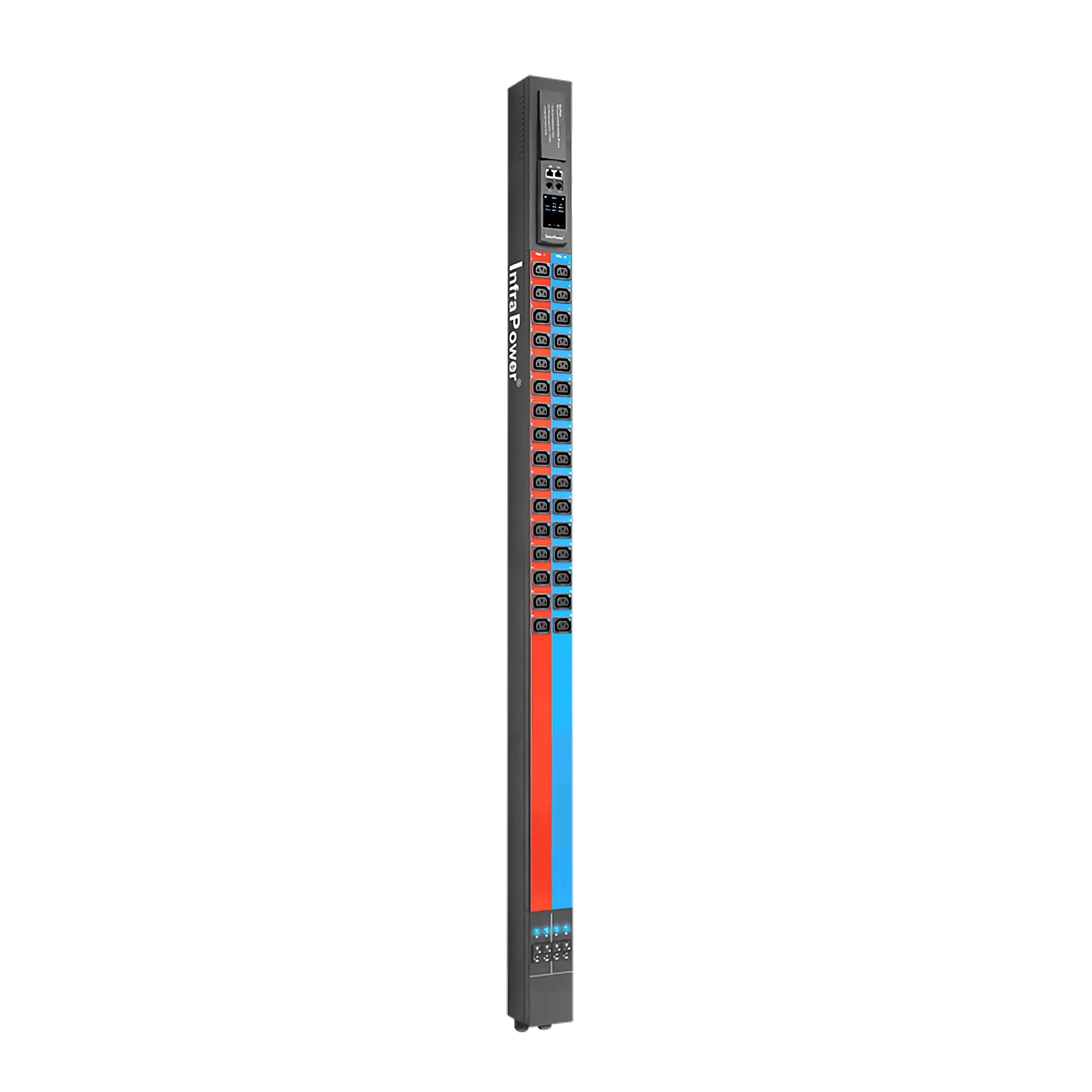
Austin Hughes 3.68kW Single Phase Dual Feed 16A/230V Socket Switched, Strip Monitored Rack PDU, 32 x C13 Outlets, EN60309 Input Plug, 10ft Cord, 0U Vertical, Product Specification:PDU Type - Switched, Phase - Single Phase, Input Plug Type - EN60309, Output Socket Type - 32xC13, Rating Voltage - 230V, Rating Current - 16A
| PDU Type | Switched |
| Phase | Single Phase |
| Input Plug Type | EN60309 |
| Output Socket Type | 32xC13 |
| Rating Voltage | 230V |
| Rating Current | 16A |
| Load Capacity | 3.68kw |
| Frequency Compatibility | 50/60Hz |
| Cord Length | 10ft (3m) |
| Cord Gauge | 1.5mm sq. H05V V-F Cordset |
| Ammetre | Field Replaceable 2.8" Color LCD with Touchscreen |
| Circuit Breaker | Resettable Fuse |
| Front Panel LCD Display | Digital metre reports PDU output current in amps, voltage, capacity, electric energy, temperature and humidity, and IP address information |
| Network Compatibility | 10/100 Ethernet & Gigabit Ethernet Standard |
| SNMP Compatibility | LED Local Monitoring and Remote Monitoring through GUI/DCIM and IPM-04 |
| Material of Construction | Sheet Metal |
| Mounting Position | Vertical |
| Rack Units | 0U |
| Minimum Required Rack Height | 38U |
| Dimensions (HxWxD) | 64.96"x3.34"x2.7" (1650x85x90mm) |
| Storage Temperature | -15 to 60°C (5°F ~ 140°F) |
| IEC Receptacle Locking | Yes |
| Operating Temperature | -5 to 60 °C (23°F ~ 42.8°F) |
| Relative Humidity | 8 to 95% RH, Non-condensing |
When a network device is used with a dual-feed PDU, if the primary power feed fails, the device will automatically switch power to the other source.
The PDU features tool-free installation and versatile mounting options, allowing vertical placement on the side or rear of the rack to optimise space and airflow in 38U and larger racks.
Recommended for data centres, server rooms and network closets. You can more efficiently manage network power consumption and properly balance loads without having to visit the site. Reducing the number of on-site visits can help lower the cost of data centre maintenance.